

Cold room panel thickness: how to choose the right one
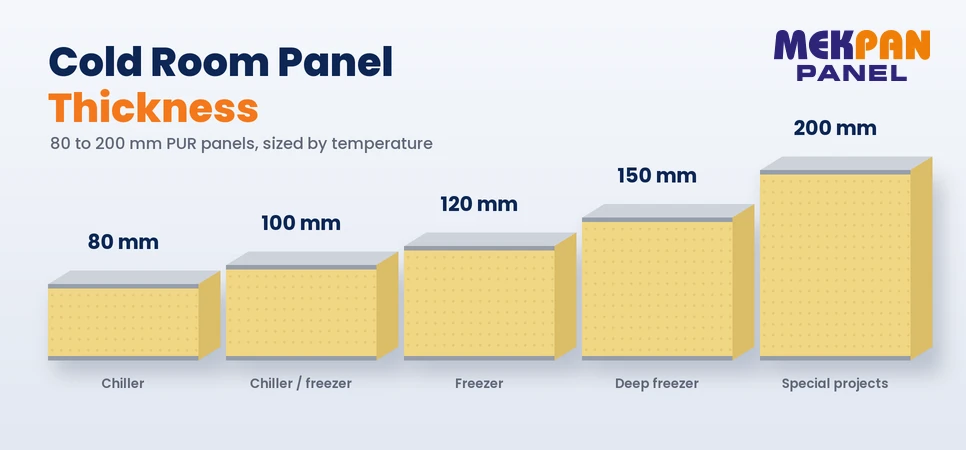
Cold room panel thickness is determined by the operating temperature of the room and the temperature of the space around it. As a general guide, 80–100 mm panels suit chillers at +5 to +15 °C, 100–120 mm panels suit rooms down to −18 °C, and 120–150 mm panels suit freezers below −18 °C. Mekpan Panel manufactures cold room panels in Türkiye in thicknesses from 40 to 200 mm.
An undersized panel shows its cost in two ways: condensation and ice at joints and corners, and higher energy consumption for the entire service life of the room. An oversized panel adds material cost without a measurable return.
The correct thickness can be calculated rather than estimated. The deciding value is the temperature difference between the inside of the room and its surroundings. The method below is based on the technical data of Mekpan cold room panels, produced in Konya and supplied through the company's Istanbul office.
Cold room panel thickness chart
| Room temperature | Typical use | Panel thickness | In inches |
|---|---|---|---|
| +5 °C to +15 °C (41–59 °F) | Fruit, vegetables, pharmaceutical packing | 80–100 mm | 3.1–3.9 in |
| 0 °C to −18 °C (32 °F to 0 °F) | Chilled meat, dairy, short-term frozen storage | 100–120 mm | 3.9–4.7 in |
| −18 °C and below (0 °F and below) | Frozen food, ice cream, long-term frozen storage | 120–150 mm | 4.7–5.9 in |
These ranges are a starting point. The surrounding temperature and the building layout can require the next thickness up, as the calculator and the following sections show.
Request a quote Ask on WhatsApp
Cold room panel thickness calculator
Enter the room temperature and the highest temperature expected around the room, such as an external wall in summer or the hall in which the room is installed. The calculator returns the thinnest panel that satisfies both the thickness chart and the heat-flow limit explained below.
Why published thickness charts differ
Published recommendations for the same chiller range from 75 mm to 100 mm. The difference rarely comes from the panels themselves. Each recommendation assumes a different surrounding temperature, and that assumption is seldom stated. A freezer installed inside a temperate warehouse and an identical freezer built against a sun-exposed external wall in southern Europe operate under very different conditions.
How the temperature difference determines thickness
Heat transfer through a panel is proportional to the temperature difference across it. Cold store design commonly limits this heat flow to 10 W/m². The table shows the largest temperature difference each Mekpan panel can accommodate within that limit:
| Panel | U-value (W/m²K) | Approx. R-value | Max. temperature difference under 10 W/m² |
|---|---|---|---|
| 80 mm | 0.247 | R-23 | 40 °C |
| 100 mm | 0.177 | R-32 | 55 °C |
| 120 mm | 0.167 | R-34 | 55 °C |
| 150 mm | 0.134 | R-42 | 70 °C |
To apply the table, subtract the room temperature from the surrounding temperature. At a 70 °C difference, for example, a 150 mm panel transmits approximately 0.134 × 70 ≈ 9.4 W/m², just within the limit. The thickness chart sets the minimum; where the temperature difference calls for more, the thicker panel applies.
Cold room panel thickness and the surrounding temperature
The same freezer specification can lead to different panel thicknesses, depending on where the room is installed.
In a European distribution centre, a −20 °C room installed in a hall at around +25 °C faces a 45 °C temperature difference. A 100 mm panel would keep the heat flow at approximately 8 W/m², but the thickness chart specifies a minimum of 120 mm for this room temperature, which makes 120 mm the appropriate choice.
If the same room is built against an external wall in southern Europe, where summer temperatures reach +40 °C (104 °F), the difference rises to 60 °C. At that point, 100 mm and 120 mm panels exceed 10 W/m², while a 150 mm panel keeps the heat flow at approximately 8.1 W/m², which makes 150 mm the appropriate thickness.
Where cold rooms lose energy
Panel thickness is only one part of an efficient cold room. Three details have a comparable effect on performance:
- Joints. Each panel joint requires a continuous seal. Even a narrow gap allows warm, humid air to enter, which leads to frost formation.
- Doors. The door is the most frequently used opening of a cold room. An insulated cold room door, short opening times and strip curtains reduce the entry of warm air.
- Floors. Freezer floors also require insulation. Below approximately 0 °C, the ground beneath an uninsulated slab can freeze and cause the floor to heave.
Information required for a cold room quotation
The following details allow an accurate panel specification:
- Room dimensions (length, width, height)
- Operating temperature
- Project location, or the highest temperature around the room
- Number and size of doors
- Products to be stored
Based on these details, the Mekpan Panel team in Istanbul, Türkiye prepares a panel specification and quotation. The full product range is available on the cold room panels page.
Frequently asked questions
Planning a Cold Room? Request a Panel Specification
Send the room dimensions, operating temperature and project location to Mekpan Panel in Istanbul to receive a cold room panel specification and quotation.
Get a Custom Quote →