

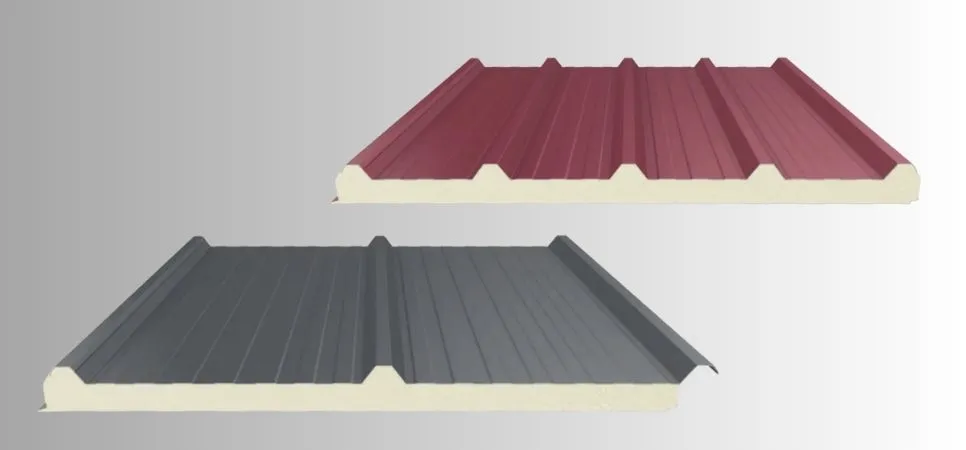
How to Choose the Right Sandwich Panel for Your Project
Sandwich panels are used in industrial buildings, warehouses, cold storage facilities, and residential buildings. They offer indispensable solutions in terms of both structural safety and insulation, but selecting the sandwich panel appropriate for the structure's characteristics is crucial for achieving full performance. An incorrectly selected sandwich panel can lead to significant costs in the future.
7 Tips to consider when selecting sandwich panels
When selecting the most suitable sandwich panel for your project, certain criteria must be considered. You can find a detailed explanation of these below.
1. The panel's insulation core material (PUR, PIR, Rock Wool, EPS)
The panel's insulation core material is located in the centre of the sandwich panel. It determines the panel's thermal and sound insulation performance and fire resistance. Therefore, sandwich panels suitable for the building's requirements should be preferred. PUR/PIR panels offer high thermal insulation and are lightweight materials. Rock wool panels have very high fire resistance. EPS-filled panels are economical but have low thermal insulation.
2. Panel Thickness and Thermal Transmittance Value (U-Value)
Increasing the panel thickness reduces the thermal transmittance value and improves insulation performance. The heat retention capacity of a 40 mm thick panel differs significantly from that of a 100 mm thick panel. A low U-value provides high energy savings. Panels with a low U-value are suitable for cold storage facilities and climate-controlled areas.
3. Quality and thickness of the outer cladding sheet
The thickness of the galvanised sheet forming the outer surface of the sandwich panel (usually between 0.40 and 0.70 mm), the paint system (PVDF, polyester, plastisol), and corrosion resistance all affect the longevity of the panel. Sheet metal with high corrosion resistance should be used for facades and roofs exposed to harsh climatic conditions.
4. Fire resistance class
Buildings must be constructed in accordance with fire regulations. PIR and rock wool panels have fire-retardant properties. They provide Class B or Class A fire resistance. They are suitable for use in public buildings, such as industrial facilities and energy production areas, where there is a high risk of fire.
5. Load-bearing capacity and mechanical strength
The load-bearing capacity of roof panels must be determined by taking into account the snow load, wind suction, and walking load that will be applied to them. The panels must be capable of bearing these loads. The spacing of the supporting system, the bending moment of the panel, and the load-bearing capacity must be calculated accurately. Mekpan Panel's technical data tables provide guidance in this regard.
6. Ease of installation and detail profiles
The quick and easy installation of sandwich panels saves companies time, enabling projects to be completed on schedule. Hidden screw systems are aesthetically pleasing and provide a leak-proof structure. The use of compatible accessories (gables, corners, edge covers, etc.) results in a comprehensive system.
7. Manufacturer Warranty and Certification
As well as the quality of the panel, the manufacturer's technical support and product certification are also important. Certificates such as TSE, CE, ISO 9001, and FM Global demonstrate quality and reliability.
Leading companies in the industry, such as Mekpan Panel, offer technical support and long-term warranty options alongside their products.
The seven criteria to consider when selecting Turkey sandwich panels make a huge difference in terms of your building's energy efficiency, safety, and durability. The right materials and professional application are essential for the successful completion of your project. With the support you receive from Mekpan Panel, you can both protect your budget and save time.
You too can consult Mekpan Panel experts for the most suitable panel solutions for your project.