

Rock wool vs. polyurethane panels:
Comparison guide
Both rock wool and polyurethane act as the ‘core material’ of a Turkey sandwich panel and, at first glance, appear to serve the same purpose. However, the core material you choose directly affects your building’s fire safety, heating and cooling bills, the weight of the panel, and your budget. In other words, this is not merely a technical choice, but a decision that determines the nature of your project’s structure.
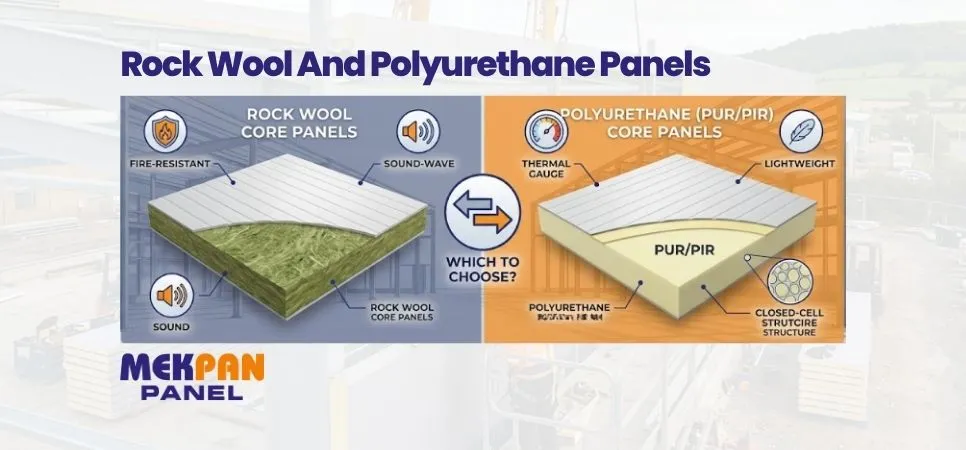
To summarise briefly: Rock wool excels in fire resistance and sound insulation. Polyurethane, on the other hand, stands out in terms of thermal insulation, lightness and cost. Below, we have compared the two side by side, in all honesty.
| Feature | Rock Wool Panel | Polyurethane (PUR/PIR) Panel |
|---|---|---|
| Core Material Structure | Mineral fiber produced from basalt stone, porous and breathable structure | Closed-cell rigid foam, waterproof and moisture-resistant |
| Fire Performance | Non-combustible material, Class A1–A2, does not contribute to fire spread | Organic-based, combustible; PIR type slows spread by charring |
| Thermal Insulation | Good, but requires a thicker panel for equivalent performance | Excellent, high insulation in a thinner panel due to low thermal conductivity |
| Acoustic Insulation | High, fibrous structure absorbs sound | Moderate |
| Weight | Heavy, exerts higher load on the load-bearing system | Lightweight, easy to transport and install |
| Moisture and Water | May absorb moisture; insulation degrades when wet | Waterproof and moisture-resistant, advantageous in cold storage |
| Cost | Generally higher, the cost of fire safety | More economical, same insulation performance with a thinner panel |
| Applications / Key Uses | Fire-critical structures, chemical plants, fuel stations, parking garages, high sound insulation | Cold storage rooms, roofs and facades, general industry, energy efficiency |
Need High-Performance Panels for Your Project?
Get price quotes and specific technical specifications for your orders directly from Mekpan Panel.
Get a Custom Quote →What is a rock wool panel?
Rock wool, as the name suggests, is derived from rock. It is produced by melting volcanic rocks such as basalt at high temperatures and transforming them into fibres. These fibres are then used as insulation within the panel. The resulting material has a porous, breathable and, most importantly, non-combustible structure.
Its greatest strength lies in its fire resistance. Rock wool panels do not contribute to the spread of flames, can withstand high temperatures for long periods and do not produce smoke. Furthermore, its fibrous structure absorbs sound very effectively. For this reason, it is the first choice of filling material for projects where fire safety or sound insulation is critical.
Its disadvantages, however, are its weight and sensitivity to moisture. It is heavier than polyurethane, which increases the load on the supporting structure. Furthermore, as its insulation value may decrease when wet, it is important that the details and installation are carried out correctly.
What is a polyurethane panel?
Polyurethane is a closed-cell rigid foam poured between two metal sheets. Thanks to this closed-cell structure, it provides excellent thermal insulation and does not absorb water or moisture. Its light weight makes it easy to install and transport.
There are two main types of polyurethane. The classic type is PUR Panel, which is classified as flammable. The improved type, the PIR panel, forms a charred layer on its surface when exposed to flame. This layer slows down the spread of fire into the interior and gives PIR a higher fire resistance rating. Therefore, Turkey PIR panel is an important option for those seeking fire safety in polyurethane applications.
Its greatest advantage is that it provides high insulation with a thin panel. It offers the same thermal insulation as rock wool but with a thinner profile, which saves on space, weight and cost. Thanks to its waterproof structure, it is indispensable, particularly for cold stores.
Which is safer in terms of fire performance?
Rock wool is mineral-based and non-combustible. It is generally classified as A1 or A2, meaning it does not fuel a fire or help the flames to spread. In the event of a fire, this is the material that buys you time.
Polyurethane, on the other hand, is organic-based and therefore flammable. However, a distinction must be made here: Turkey PIR panel performs much better than PUR, charring when exposed to flames to slow down their spread. Nevertheless, in terms of pure fire performance, rock wool remains the safer option.
In practice, the decision is often dictated by regulations. In high-fire-risk buildings such as chemical plants, petrol stations, covered car parks and public buildings, rock wool may be mandatory. In such projects, the fire rating of the panels must be clarified from the outset.
Is there a difference between thermal and acoustic insulation?
Yes, and here’s the interesting thing: the winner is different in each case.
Polyurethane leads the way in thermal insulation. Its thermal conductivity is lower than that of rock wool, which means it can provide the same level of insulation with a thinner panel. If energy efficiency and a slim profile are your priorities, polyurethane is the sensible choice.
When it comes to sound insulation, however, rock wool comes out on top. Its porous, fibrous structure absorbs sound waves. Rock wool makes a real difference in spaces where production noise, external ambient noise or echoes are a concern. If you’re curious about the thermal side of things, you might also want to take a look at our article on thermal insulation in sandwich panels.
Weight, installation and cost
Polyurethane panels are lightweight. This means less load on the supporting structure, faster installation of the panels and reduced labour costs.
Rock wool, on the other hand, is heavier. This weight requires the supporting structure to be designed accordingly and demands greater care during installation. Rock wool is also generally more expensive in terms of total cost; however, it is more accurate to view this not as a disadvantage, but as the price paid for fire safety.
In short, polyurethane represents the ‘fast, lightweight, economical’ side, whilst rock wool represents the ‘safe, robust, quiet’ side.
Which one should you choose?
The correct answer depends on clarifying your project’s priorities. You could look at it this way:
If fire risk or regulatory compliance is critical (chemicals, petrol stations, car parks, public buildings), rock wool panels are the better choice.
If sound insulation is important (certain production facilities, noisy environments), rock wool is again the preferred option.
If energy efficiency, light weight, quick installation and budget are your priorities, polyurethane panels offer advantages.
If you are looking for both cost-effectiveness and enhanced fire performance, PIR panels strike the right balance.
At Mekpan Panel, we manufacture high-performance polyurethane and PIR panels. Please get in touch so that we can work together to identify the right solution for your project, taking into account its fire rating, panel thickness and intended use.