

Winter maintenance for sandwich panel roofs in Turkey
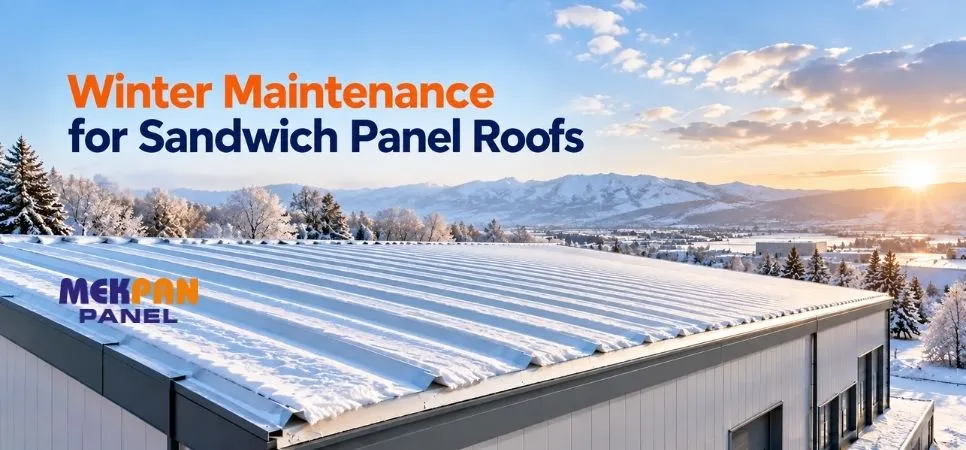
A roof can look sound from the ground and still give you trouble when the weather turns. A blocked outlet, a worn seal around a fixing, a joint that no longer closes properly — small defects become much more noticeable once rain and cold arrive together.
Start there. Before winter, check how your sandwich panel roof drains, where moisture appears and whether its joints and flashings remain in good condition. If the building feels cold despite the heating running, look at insulation and air leakage too.
Is Your Sandwich Panel Roof Ready for Winter?
Contact Mekpan Panel in Turkey with your project details to discuss roof panel options, insulation requirements and product information.
Discuss Your Roof Project →At Mekpan Panel, we manufacture sandwich panel in Turkey, with a regional office in Istanbul. For anyone choosing roof panels or maintaining an existing building, the useful question is simple: what does this particular roof need to cope with?
Water on the floor? Find out where it starts
A puddle beneath the roof tells you very little on its own.
Perhaps rain has found a route through a damaged flashing. Perhaps melting snow cannot drain away. Or moisture from inside the building has condensed on a cold surface and dripped down. Each calls for a different repair.
Keep a short record before arranging an inspection. Note the weather, the position of the drip and what was happening indoors. Did it appear during heavy rain, after a thaw or on a dry morning following a cold night? Include any recent change in how you use the building.
Those details help narrow the search; they do not settle it. Water can travel along a joint or support before dropping, so the visible wet patch may sit some distance from the actual defect.
Why insulated roof panels can still develop condensation
Insulation reduces the risk of condensation. It does not make a roof immune.
Moisture turns into droplets when the inner surface becomes colder than the dew point of the air beside it (the temperature at which that moisture begins to condense). That can happen even with correctly installed panels if indoor humidity rises enough or a surface becomes sufficiently cold.
Think about the building's daily use. Washing equipment, wet stock, livestock and concrete that is still drying all add moisture. A gas heater that releases its combustion gases straight into the room adds water vapour as well.
Treat the cause. Where a process produces moisture, assess extraction and replacement air. Where dampness follows a roof junction, check insulation continuity and the seals. Do not close designed ventilation openings simply because the building feels draughty; you may retain more moisture along with the heat.
If condensation keeps returning, ask for a review of the indoor conditions and roof construction together. Replacing panels without that diagnosis can leave you with the same problem.
Heat loss: the panel and the gaps both matter
A gap lets air move. A thermal bridge lets heat pass more readily through a local detail. They can occur in the same area, but they are different faults.
Take the ridge. Its outer flashing sheds weather, while the insulation and sealing beneath it serve different purposes. Fitting a new cover over an incomplete detail may leave the thermal problem untouched.
Roof-to-wall junctions, eaves and penetrations deserve the same attention. Check rooflights too — their thermal performance may differ from the adjoining panels, and their perimeter joints need their own inspection.
Would thicker panels help?
With the same insulation material, more core thickness generally means less heat passing through the panel. Compare the declared U-values of the products you are considering rather than choosing on thickness alone.
The right choice depends on what you need indoors. A warehouse that stores dry goods has different demands from a heated production area or a temperature-controlled room. Repairing air leaks may help an existing building; a new roof needs a specification that accounts for its intended use from the outset.
And keep the savings in perspective. Better roof insulation can reduce heating demand, but it cannot promise a matching percentage reduction in your energy bill. Doors, walls, ventilation and operating hours still affect the total.
Clear the drainage before it becomes a repair job
Check gutters, valley gutters, outlets and downpipes before wet weather exposes a blockage. Debris can leave water standing where the roof was meant to drain.
Freezing adds another complication. Ice can restrict an outlet even after you have cleared the leaves, so repeated overflow or ponding needs more than another clean.
Inspect from a safe position. If access requires roof work, arrange a competent team and a planned means of reaching the area.
Snow loading is a design question
You cannot judge a roof's snow capacity by counting its ribs.
For sandwich roof panels, the designer needs the manufacturer's load-span information for the actual product and support arrangement. Panel depth, metal thickness, fixings, purlins and the main frame all contribute to the assessment. The site and roof shape determine the loading conditions.
Snow does not always settle evenly, either. Wind can create accumulations beside parapets or where roof levels change; those areas need consideration during design.
If snow removal becomes necessary, let a competent team decide how to proceed. Walking over the purlin line does not establish safe access. Nor can you rely on seeing every rooflight through a covering of snow.
What should a winter roof inspection cover?
Give the inspection team any previous leak records, then ask them to review:
- Drainage routes and signs of standing water.
- Ridge, edge and junction flashings.
- Panel joints, penetrations and rooflight connections.
- Fixings, washers and evidence of movement.
- Coating damage, corrosion and internal damp marks.
Make ventilation and extraction checks part of the building maintenance plan as well.
Avoid a quick layer of sealant over every suspect joint. Repair materials must suit the panel system, and tightening a screw further is not automatically the answer to a leaking washer. Coating damage also needs assessment before repainting — covering corrosion does not deal with its cause.