

PUR vs. PIR panels: Which should you choose?
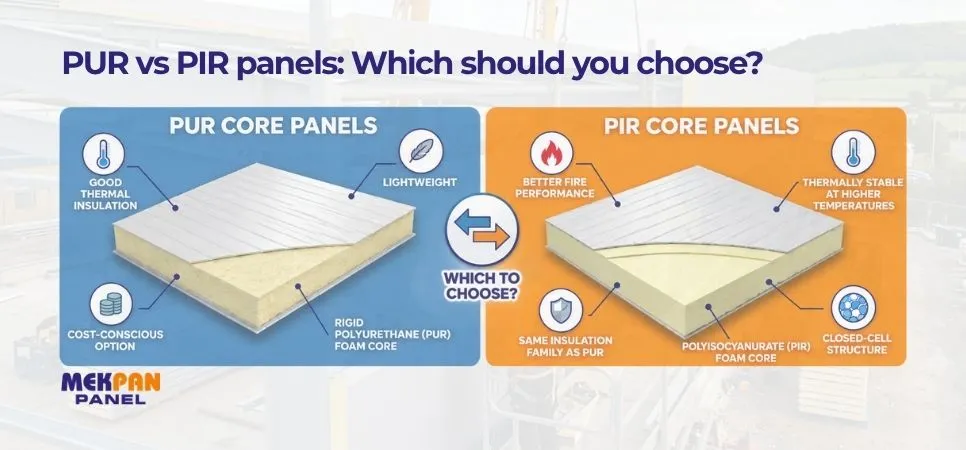
PUR and PIR panels can look almost identical once they are installed. Both use a rigid foam insulation core between two metal sheets. Both are lightweight. Both can provide strong thermal insulation. That is why choosing between them is not always straightforward.
The better option depends on the building itself. A standard warehouse roof, a chilled food-storage room and a production facility with demanding fire requirements do not need the same specification. Temperature targets, panel thickness, fire classification, roof span and budget should all be considered before an order is placed.
PUR sandwich panel in Turkey
A PUR sandwich panel has a core made from rigid polyurethane foam. During production, the foam is injected between two metal facings, where it expands and bonds to the sheets.
PUR foam has a closed-cell structure. This helps reduce heat transfer and makes it a widely used insulation material for roof, façade and cold-room panels. It is also light, which supports faster installation and reduces the dead load placed on the structure.
PUR panels are often selected for projects that need reliable insulation at a cost-conscious level. The final performance still depends on the panel thickness, metal facing, profile and installation details.
PIR sandwich panel in Turkey
Turkey PIR sandwich panel also uses rigid foam insulation, but its core is polyisocyanurate rather than standard polyurethane. PIR belongs to the same insulation family as PUR. It is not a separate type of sandwich panel in the way that rock wool or EPS panels are.
The main difference is in the foam formulation. PIR contains a higher proportion of isocyanurate structures, which makes the foam more thermally stable at elevated temperatures. In many projects, this makes PIR the preferred option where fire performance is a more important part of the specification.
PIR panels can be used for roofs, façades, internal partitions and temperature-controlled buildings. However, the correct choice should always be based on the tested product data rather than the name of the core alone.
PUR vs PIR panels: Which should you choose?
Please contact Mekpan Panel to discuss the technical documentation required for your building.
Get a Custom Quote →PUR or PIR panels
There is no universal winner between PUR and PIR panels. Each core can be suitable when it is matched to the right building and correctly specified.
1. Chemical structure and how it affects performance
PUR and PIR foams are made from related raw materials. The difference comes from the formulation and the way the material cures during production.
PIR forms a more cross-linked structure than PUR. This is the reason it tends to remain more stable when exposed to higher temperatures. Under fire conditions, PIR foam may develop a char layer that can slow the transfer of heat into the material beneath it.
2. Thermal insulation and U-value
Both PUR and PIR are high-performance insulation cores. Their closed-cell structure helps limit heat flow through the panel, making them useful where a thinner wall or roof build-up is preferred.
A panel’s U-value should not be judged by the foam name alone. Thickness is important. A 40 mm panel and a 100 mm panel made with the same core will not offer the same thermal performance. Joint details, fixings and thermal bridges also affect the completed building.
For this reason, it is better to start with the required U-value or internal temperature target. The manufacturer can then recommend a suitable core type and thickness for the project.
3. Fire performance
Fire performance is one of the main reasons buyers compare PUR and PIR panels. PIR is commonly chosen where a stronger reaction-to-fire classification is required.
4. Strength, weight and installation
The core material plays a part in panel behaviour, but it does not decide structural performance by itself.
Panel span capacity depends on several details:
- Panel thickness
- Steel or aluminium facing thickness
- Roof profile
- Purlin spacing
- Wind and snow loads
- Fixing arrangement
- Building location and use
A well-specified PUR panel may be more suitable than an incorrectly specified PIR panel. This is why load tables and project calculations matter, especially for long roof spans and exposed locations.
Both PUR and PIR sandwich panels are light compared with many traditional wall and roof systems. This can simplify transport, lifting and installation. Proper alignment, sealing and fixing are still essential. A weak joint can reduce insulation performance even when the panel core itself is high quality.
5. Moisture resistance and long-term performance
PUR and PIR foam cores have closed-cell structures, which helps them resist moisture absorption. In practice, long-term performance depends heavily on the entire panel system.
Water can enter through damaged coatings, incorrectly sealed joints, poorly installed flashings or penetrations around pipes and fixings. Once moisture reaches areas where it should not be, corrosion and reduced thermal performance can follow.
The panel should therefore be selected with the right coating, joint detail and accessories for the environment. A coastal site, a humid food-production area and a standard inland warehouse do not place the same demands on metal facings.
6. Cost
PIR panels often cost more than PUR panels. Whether that additional cost is worthwhile depends on the project.
If the building has standard insulation requirements and no higher fire-performance demand, PUR may provide the more economical solution. If the building specification requires a particular fire classification, a thinner thermal build-up or greater thermal stability, PIR may offer better value over the life of the project.
PUR vs PIR panels for cold storage
Cold-storage buildings need more than insulation. They need a continuous, well-sealed envelope that prevents unnecessary heat gain and limits the risk of condensation.
The target room temperature should be considered first. A chilled storage room, a freezer room and a food-processing area all operate differently. The required panel thickness may change significantly depending on the temperature difference between the inside and outside of the building.
Joints are equally important. Cold room panels need properly designed connections and sealing to help maintain airtightness. Doors, floor insulation, ceiling panels and service penetrations should be planned as part of the same thermal envelope.
PIR is often considered for cold-storage projects because of its thermal stability and fire-performance advantages. PUR may also be suitable where the project requirements allow it. The best approach is to share the room dimensions, intended use and operating temperature before choosing the panel specification.
Planning a Cold Room or Temperature-Controlled Facility?
Send Mekpan Panel your dimensions and operating temperature for panel-thickness guidance and a project-specific quotation.
Get a Custom Quote →PUR vs PIR roof panels
Turkey roof panels are exposed to more than temperature changes. They must deal with wind, rainfall, solar exposure, snow loads and the movement created by the building structure.
PUR and PIR roof panels should be selected according to the required insulation level, roof span and fire-performance needs. The rib profile also matters because it affects load distribution and drainage.
For standard industrial roofs, PUR may provide an efficient and cost-effective solution. PIR can be more appropriate when the project calls for enhanced fire performance or a higher level of thermal stability.
Mekpan’s 3-ribbed roof panels and 5-ribbed roof panels can be assessed according to roof span, panel thickness and the structural requirements of the project. If solar equipment is planned, the support system and roof-panel compatibility should also be reviewed before installation.
PUR vs PIR façade panels
Façade panels affect both the energy performance and appearance of a building. They can be produced with visible fixings, concealed fixings or different surface profiles depending on the architectural design.
For façades, the choice between PUR and PIR should consider thermal targets, fire documentation, coating requirements and the exposure of the building. A humid industrial area, a coastal location or a chemical-processing environment may require a more durable coating system regardless of the insulation core.
The panel layout should also be planned carefully. Openings, corners, transitions and service penetrations need suitable accessories and accurate installation. A façade can only perform as intended when the panel, fixing and joint details work together.
Need PUR or PIR Panels for a Roof or Façade Project?
Contact Mekpan Panel to discuss the panel type, thickness, profile and technical documentation required for your building.
Get a Custom Quote →How to choose between PUR and PIR panels
The easiest way to choose is to begin with the building rather than the panel name.
- What will the building be used for?
- What U-value or temperature-control target is required?
- Which fire classification is required by the project?
- What panel thickness and span are needed?
- Does the specification require a tested panel system?
- Is initial price or long-term operating performance the priority?
Once these points are clear, the panel choice becomes much more straightforward. A manufacturer can then recommend the appropriate roof, façade or cold-room panel together with the required thickness and accessories.
Get technical guidance for your PUR or PIR panel project
Choosing between PUR and PIR panels is easier when the project requirements are clear. Share your building type, dimensions, roof or façade layout, required temperature conditions and any fire-performance criteria with Mekpan Panel.
The team can help you compare suitable panel options, determine an appropriate thickness and prepare a project-specific quotation for your roof, façade or cold-room application.