

Buying PUR sandwich panels from Istanbul, Turkey
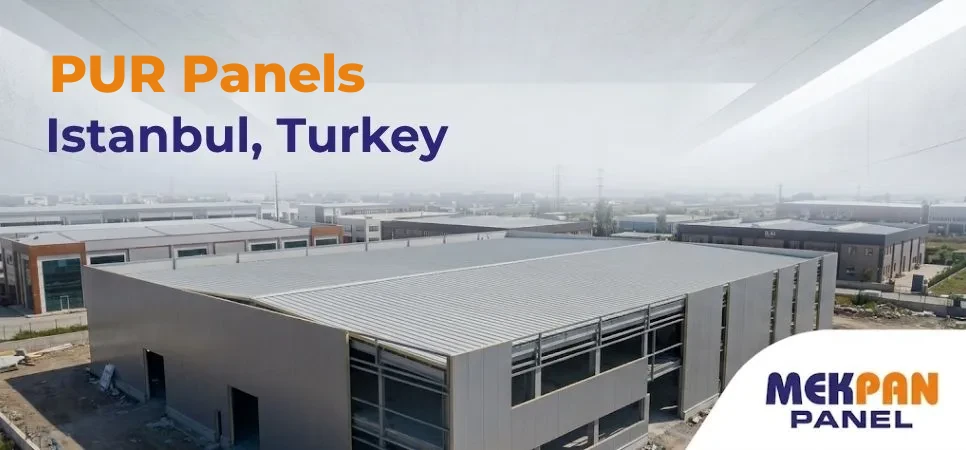
Two steel sheets. A layer of foam in between. That's a PUR panel, more or less.
PUR is short for polyurethane. At our factory in Konya, rigid polyurethane foam goes in between two painted galvanised steel sheets and bonds to both faces as it cures. What comes off the line is one stiff, light, insulated board. It goes up fast and keeps the heat where you want it.
Buyers tend to ask us the same handful of questions. Here are the answers, straight — the way we'd give them on the phone.
Why polyurethane still wins most jobs
Simple: you get a lot of insulation for very little thickness and weight.
Put a PUR core next to a rock wool core of the same thickness and the PUR panel comes out lighter (you notice it when you're carrying one across a roof) and insulates better per millimetre. Slimmer panels, easier lifts, quicker days on site. And the price usually lands lower too.
Our standard core has a density of 40 kg/m³, ±2, tested to EN 1602. Dense enough to stay rigid. Light enough to keep handling easy.
What that adds up to:
- Fast installation — panels arrive cut to length, 1000 mm wide, ready to fix.
- One product doing two jobs: cladding and insulation.
- Fewer joints, so fewer places for air and water to sneak in.
- A clean finish, inside and out.
PUR panels for roofs, walls and cold rooms
Roof panels: 20 to 100 mm, your call
Our 3 ribbed and 5 ribbed roof panels take a PUR core anywhere from 20 to 100 mm, with a 0.50 mm top sheet and a 0.40 mm bottom sheet as standard. On some profiles you can swap the steel for aluminium — handy near the coast. Want every size in one place? It's all on our roof panel dimensions page.
Facade panels (yes, hidden screws too)
For walls, the hidden screw facade panel runs from 30 to 100 mm and tucks every fixing inside the joint. Clean lines; no screw heads catching the light.
The sinus facade panel is a different animal. Wavy profile, 50 or 60 mm thick, 0.60 mm outer sheet. Which one fits? That comes down to the look your architect wants — and the budget.
Cold rooms — where every millimetre counts
Cold storage is unforgiving. The core has to suit the temperature you're holding, and the joints have to be tight; a few millimetres of gap will cost you energy every single day. Tell us the room size and the operating temperature, and we'll size the cold room panel around them.
Thickness: thinner than you'd think?
Often, yes — PUR does more per millimetre than most cores, so a 60 mm panel covers plenty of general industrial buildings, and you only push to 80 or 100 mm when the building is heated hard, cooled hard or sits in a rough climate (get the U-value from your designer first, then pick the thickness; not the other way round).
Fire — where PUR hits its limit
Let's be honest about this one.
Our PUR panels carry a B-s2,d0 rating under EN 13501. In plain English: a limited contribution to a fire (B), a medium amount of smoke (s2) and no burning droplets (d0). For a foam-core panel that's a respectable result, and it's good enough for a lot of warehouses and factories.
But it isn't non-combustible. If your insurer, your fire engineer or the local rules ask for more, look at PIR panels — they cope with heat better. Or go all the way to rock wool, the non-combustible option. Heavier, pricier — and sometimes simply not up for debate.
PUR or PIR? A quick gut check
If fire performance drives the spec, lean PIR; if cost and insulation drive it, PUR usually does the job — the full side-by-side is in our PUR vs PIR guide.
Ordering PUR panels from Turkey for a UK or European project
Buying from abroad sounds like a hassle. It isn't, really — as long as the details are on the table before anyone prices the job.
We make every panel at our plant in Konya and handle sales through our office in Istanbul. Panels come off the line cut to the length you order, from 2.4 m upwards, so nobody on your site has to trim them. The catch is transport. Very long panels get awkward on a standard articulated lorry, and containers have their own length limits; so we check the route with you before we lock in the sizes.
Send us these and you'll get a proper quote, not a guess:
- Drawings, or at least the roof and wall dimensions
- Panel type and the thickness you have in mind
- Colour — a RAL code is ideal
- Purlin or rail spacing
- Delivery address
- Any fire or insulation targets from your designer
Missing a few? Fair enough. Send what you have and we'll fill the gaps together.
One more thing. Check early which test reports and declarations your project needs. Sorting the paperwork before production is far easier than chasing it after.
What actually drives the price per m²
No secret formula. These move the number:
- Core thickness — the biggest lever by far.
- Steel thickness. Thicker sheets, higher price.
- Coating and colour; standard colours usually cost less than special finishes.
- Panel length, and how much offcut the job creates
- Order size
- Transport — the distance and route to your site in the UK or Europe.
Quick answers
Got a project? Let's talk numbers
Mekpan Panel makes PUR sandwich panels in Konya, Turkey, and our Istanbul office handles quotes for buyers at home and abroad. Send the details. We'll do the maths.
Need PUR Panels from Turkey for Your Project?
Send Mekpan Panel your drawings, panel type and delivery location for a project-specific quotation.
Get a Custom Quote →